22
PAL signal
Scan Velocity Modulation module,
The PAL CVBS signal from module pin 6 is input to multi-
plexer pin 4. Due to the low level on control pin 9 (noteVM600
inverter tc10), the signal is output from pin 5, and onward
General
via an amplifier stage tc7 / tc8 to a low pass filter. After the
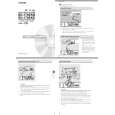
The purpose of the Scan Velocity Modulation (SVM) mod-
LPF and buffer transistor tc9, the signal is input to pin 15 of
ule is to increase the sharpness of the picture during inten-
the comb filter IC.
sity transients of the luminance signal.
In the comb filter IC, the composite video is clamped to an
The scan velocity modulation is carried out so that the lu-
internal level and then converted by a high speed 8-bit A/D
minance signal (a), which contains intensity transients, is
converter. The conversion frequency is four times the col-
first differentiated and then amplified (b).
our subcarrier frequency. Due to the PAL standard, the Fsc
In this way the signal produced is fed to an auxiliary coil,
on pin 45 is 4.43 MHz, thus the conversion frequency is
which is situated at the neck of picture tube. The current
17.7 MHz.
which flows through the SVM coil during intensity tran-
A logical low on pin 41 drives the video data in to the comb
sients modulates the deflection field (c), and thus either
filter processing block and a logical low on pin 47 defines
speeds up or slows down the scan velocity.
the filtering method in accordance with the PAL standard.
The separate luminance and chrominance signal data is
then converted into analog form by two 8-bit D/A convert-Chess patternGrid pattern
White
ers. The conversion is carried out using the same clock
frequency of 17.7 MHz.Luminance
The luminance signal is output from pin 6, via the emittersignala)
follower tc11 into multiplexer pin 12, out from pin 14, and
then on through the emitter follower tc6 to the moduleBlack
output pin 10.
The chrominance signal is output from pin 8, via tc12 intoSVMScan velocity slower
b)
multiplexer pin 2 and output from pin 15, and then onsignalScan velocity faster
through tc4 to module output pin 11.
c)
NTSC 3.58 signalDeflection
The signal routes are exactly the same as the PAL signal
routes. The only difference takes place in the comb filter-Basic principle of Scan Velocity Modulation
ing system inside the comb filter IC. Pin 47 is high, thus a
different filtering method is selected. The conversion fre-
The luminance signal is first derived by two consecutive
quency is now 14.3 MHz due to the Fsc of 3.58 MHz on pin
differentiators consisting of cvm2/rvm2 and cvm1/rvm1/
45.
rvm3.
The derived signal is preamplified by transistors tvm1 and
NTSC 4.43 and SECAM signals
tvm2, and then fed to the limiter stage, which consists of a
The signal route to the comb filter IC is the same as above.
differential amplifier, transistors tvm3 and tvm4.
However, now pin 41 is high and thus the comb filter IC is
The limited signal is then fed via a driver stage (tvm6 and
in bypass mode. The signal is fed only via the A/D con-
tvm7) to transistors Tvm8 and Tvm9, which form the out-
verter, memory block and D/A converter. The conversion
put stage, and onwards to the SVM coil.
frequencies are 17.7 MHz (NTSC) and 17.1 MHz (SECAM).
The NTSC 4.43 and SECAM signals are fed via the comb
filter IC because the internal memory block imposes a two
line delay on the signal. If these signals were already by-
passed in the multiplexer and the received standard
changed, for example, from SECAM to PAL, a momentary
loss of sync would occur.
S-VHS signal
The S-VHS signal is input to module pins 6 (Y) and 7 (C)
and onward to the multiplexer, pins 4 and 1. Pin 1 of the
module is now low, and this causes control pin 9 to go
high, and the internal switches of the multiplexer change
to bypass mode. The luminance signal is output from pin
14 and chrominance signal from pin 15.
If the transmission is a pure monochrome signal or pure
noise, meaning that there is no burst, the signal is bypassed
like an S-VHS signal. This is because there is then no col-
our subcarrier which is needed in the signal processing. |

 ACEC
ACEC HITACHI