SECTION IV
USE IN ANTENNA ADJUSTMENT
*Since most antennas are relatively high "Q" of antenna arrays with the aid of a receiver as a
circuits with distributed constants, only very signal strength indicator connected to the antenna.
loose coupling to the Model 59 need be used. It The Model 59 can .be used to determine whether
will be necessary to couple inductively to the cur- a transmisslon llne is properly matched at a par-
rent maxima or capacltlvely to the voltage maxima. ticular frequency, by operating in the "DIODE" po-
Most antennas have harmonic mode responses sition and coupling to the transmission line as
which can also be located and measured by the Model shown in Figure 10. surricient coupling should be
59. Both harmonic and fundamental rrequency mea- used ror a reliable readlng with power applied to
surements can be made with the swiqch In the "CW" the transmissioh line, then the coupling should be
position, and no power applied to the antenna under held constant as the Model 59 probe is mo*?d at
test. This lessens the possibility or interrer- least 1/4 wavelength along the line. If no appre-
ence to others during antenna adjustment. ciable variation in indication can be noticed, the
line does not have standing waves and is correctly
The shift or antenna resonant rrequency with
addition of rerlectors and directors can be observed terminated at that particular rrequency.
with the Model 59. Loading coils and other shorten- The above method cannot be applied to coaxial
ing devices can also be adjusted with the Model 59.
lines; hence it is usualfy customary to adjust the
The Model 59 can be used as a field strength load and matching network ror maximum output; since
indlcator in the "DIODE" position, and when placed under conditions of maximum output, the line must
at a suitable distance from transmitter antenna be matched. For determining maximum output the
arrays, it can be used to indicate proper adjust- Model 59 can be used in the "DIODE" condltlon as a
ment of the array spacing for maximum output sig- rleld strength indicator suitably coupled to the
nal. Alternatively it can be used as a signal radiating antenna.
source (in the "MOD" position) ror the adjustment
Matching stubs can be pre-adjusted to tb
proper rrequency by observation or their resonant
rPequenCY with the aid of the Model 59. Quarter-
wave stubs should be shorted at one end and coupled
inductively to the Model 59. (See Figure 11) It
will be possible to locate several odd-harmonic
modes also.
Hair wave stubs should be iert open and in-
ductive coupling to their center utilized ror
checklng natural resonance. For coaxial half wave
stubs capacitative coupling to one end can be used.
In this case several even harmonic modes may also
be located.
Note: Inductive coupling may be more convenlent for
low-Q stubs.
Capacity coupling is quite satisfactory for
Hi-Q stubs.
lots : trient for maxlmm inductive coupling (on On co-axial stubs, a noticeably dlp may be ob-
DIODE"), with power applied to line;
tained by inductive coupling to the shorted
2. Move linearly along line for a distance of end of si le braid co-axial stubs in the LOO
one quarter wave' or more while maintaining to 400 m+ requency range. This occurs because
constant spacing. of the imperfect shielding action of ttle-outer
braid conductor at these higher frequencies.
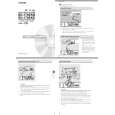
Figure 10 - CHECKING FOR STANDING WAVES
ON TRANSMISSION LINES Figure 11 - COUPLING To OUARTER-WAVE STUBS
16. |

 ACEC
ACEC OTHERS