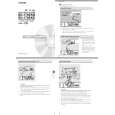
1.1.2 Safety Check after Servicing
Examine the area surrounding the repaired location for damage(4) Leakage current test
or deterioration. Observe that screws, parts and wires have beenConfirm specified or lower leakage current between earth
returned to original positions, Afterwards, perform the followingground/power cord plug prongs and externally exposed ac-
tests and confirm the specified values in order to verify compli-cessible parts (RF terminals, antenna terminals, video and
ance with safety standards.audio input and output terminals, microphone jacks, ear-
(1) Insulation resistance testphone jacks, etc.).
Confirm the specified insulation resistance or greater be-Measuring Method : (Power ON)
tween power cord plug prongs and externally exposedInsert load Z between earth ground/power cord plug
parts of the set (RF terminals, antenna terminals, video andprongs and externally exposed accessible parts. Use an
audio input and output terminals, microphone jacks, ear-AC voltmeter to measure across both terminals of load Z.
phone jacks, etc.).See Fig.9 and following Fig12.
See table 1 below.
(2) Dielectric strength test
Confirm specified dielectric strength or greater betweenab
power cord plug prongs and exposed accessible parts of
the set (RF terminals, antenna terminals, video and audioZAcExternally
input and output terminals, microphone jacks, earphoneexposedV
jacks, etc.). See Fig.11 below.accessible part
(3) Clearance distanceFig.9
When replacing primary circuit components, confirm spec-(5) Grounding (Class 1 model only)
ified clearance distance (d), (d') between soldered termi-Confirm specified or lower grounding impedance between
nals, and between terminals and surrounding metallicearth pin in AC inlet and externally exposed accessible
parts. See Fig.11 below.parts (Video in, Video out, Audio in, Audio out or Fixing
screw etc.).
Measuring Method:
Connect milli ohm meter between earth pin in AC inlet and
exposed accessible parts. See Fig.10 and grounding spec-
ifications.
Fig.8
Fig.10
Fig.11
Fig.12
NOTE :
These tables are unofficial and for reference only. Be sure to confirm the precise values for your particular country and locality.
1-4 (No.86712) |

 ACEC
ACEC