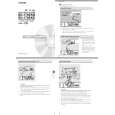
TO REMOVE CRT (Same procedure for R, G, B)
1. Remove CRT DRIVE Board, S. V. M. COIL and
DEF. YOKE from CRT.
2. Remove Lens Assembly.
3. Detach CRT Anode Cap from CRT.
4. Remove CRT Assembly from CRT Mounting.Anode Cap
CRT REPLACEMENT (Same procedure for R, G, B)
Reverse the removal procedures except the followings.
1. Anode Cable should be replaced with new one.
See OSERVICING PRECAUTIONS� shown below.
2. Install silicon (T461B) to the CRT, replace the Anode
cable and put enough silicon again on around the An-
ode Cap as illustrated.
GENERAL ADJUSTMENTS
CAUTION: Align the Anode cable as illustrated on page
4.Silicon
(On shaded area)
TSE3843W #23960136
ADJUSTING PROCEDURE IN REPLACING CRT
1. R.G.B. FOCUS ADJUSTMENT (page 7.)
2. PICTURE TILT ADJUSTMENT (page 7.)
3. USER CONVERGENCE CENTER CHECK
(See owner's manual.)
4. CENTERING ADJUSTMENT (page 7.)
5. CONVERGENCE ADJUSTMENT (page 14.)
6. WHITE BALANCE ADJUSTMENT (page 13.)
Adjustments are complete.
SPECIFIC INFORMATIONS
2 ~ 5 mm
15 ~ 25 mm
SERVICING PRECAUTIONS
� Do not use a magnetized screw driver for screws� When replacing the anode cap assembly (CRT) or
of Deflection Yoke and Velocity Modulation Coil toanode lead assembly (F.B.T.), remove the anode
avoid magnetization of electron gun.lead holder from old one and attach the holder
Magnetization of electron gun will degrade basicagain to new anode lead.
function and result in unbalance of right and left
shift of user static convergence, and result in no
variable quantity.� Check the point of anode lead in a straight
line, if it is winding, please revise it.
Screw for
D.YAnode lead holder
Screw for SVM coil
� 5 � |

 ACEC
ACEC