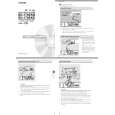
12 Remote Programming
Setting the CATV & VCRCodes
You can program your remote to operate your cable box or satellite receiver by using the instructions
and codes listed below. If the equipment does not respond to any of the codes listed below or to the
code search function, use the remote control supplied by the manufacturer.
Cable Box or Satellite setup
The remote control is programmed with CATV and/or Satellite codes for power on, power off, channel up,
channel down, and 10 key operation.
1) Find the CATV/Satellite brand from the list of codes shown below.
2) Slide the 2-way selector switch to OCATV�.
3) Press and hold down the DISPLAY button.
4) With the DISPLAY button held down, enter the first code number listed using the 10 key pad.
5) Release the DISPLAY button.
6) Confirm the operation of the Cable Box/Satellite receiver.
Y If your CATV or Satellite box does not respond to the first code, try the others listed. If it does not
respond to any code, try the Search Codes Function at the bottom of the page.
CABLE BO X E SCODESCABLE BO X E SCODESD I G I TA LCODES
S AT E L L I T E
ABC024Puser032S Y S T E M S
Archer032, 025RCA061, 070
Cableview051, 032Realistic032Echostar100
Citizen022, 051Regal058, 064, 040, 041, 042, 045,G.E.106
Curtis058, 059068Gradiente112
Diamond024, 032, 025Regency034Hitachi104, 111
Eagle029Rembrandt037, 032, 051, 038HNS (Hughes)104
Eastern034Samsung051Panasonic105
GCBrand032, 051Scientific Atlanta057, 058, 059Philips102, 103
Gemini022, 043SLMark051, 047Primestar108
General Instru m e n t065, 024, 025, 026, 027, 020,Sprucer051, 056RCA106, 109, 110
021, 022, 057, 023Stargate032, 051Sony107
Hamlin040, 041, 042, 045Telecaption067Toshiba101
Hitachi049, 024Teleview047, 051Uniden102, 103
Jerrold065, 024, 025, 026, 027, 020,Texscan044
021, 022, 057, 023Tocom035, 036, 066
Macom049, 050, 051, 054Toshiba050
Magnavox033Unika032, 025
Memorex030Universal022, 032
Movietime032, 051Videoway052
Oak039, 037, 048Viewstar029, 030
Panasonic055, 056, 060Zenith063, 046
Paragon063Zenith/Drake 046
Philips028, 029, 030, 052, 053, 031,Satellite
069
Pioneer047, 062
Pulsar051, 032
Search Codes Function:
1) Slide the 2-Way Mode Selector switch to CATV.
2) Press the TV POWER and RETURN+ buttons. Hold for at least three seconds and release.
3) Press TV POWER, see if the CATV or Satellite box responds.
4) If there was a response, press RETURN+. The operating codes are now set. If there was no response,
repeat Step 3. If you repeat Step 3 64 times without a response, use the remote control which came
with the equipment. |

 ACEC
ACEC