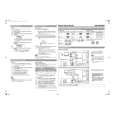
3. PB MODE
FMSW NOISE
LPFDEMOD
LIMCOMPEN.
FM PB IN
13AMP
D.O.HOLD
DETPULSE GEN8A SW
PULSE
FMFMSW NOISE
LPFDEMOD
ALCLIMCOMPEN.
Hi-Fi DET
ENVE/
14FM
HiFi
DET
AUDIO OUT(L)
FM
30AMPPNRLPF
DE-EMPH
OUTPUT
MOD OUT27
SW
FM
29AMPPNRLPF
DE-EMPH
AUDIO OUT(R)
NORMAL AUDIO 26
(1) Signal Flow
FM signal input to the Pin 13rd is amplified, and ditributed to the two BPFs-1.4MHz and 1.8MHz. The band passed
FM signals are supplied to the De-Modulator unit. First, the FM LIM confines the FM to the limitted level, and then the
signals are demodulated. The converted audio signals are compensated by the SW NOISE COMPEN. The signals
are passed by the LPF, and de-emphasized by the FM DE-EMPH in order to restrict the FM back-noise. The PNR
processor expands the signals and reduces the audio noise.
The two Line AMPs amplifiy the audio level, and supply to the Audio Out Pin 30th, 29th. The Mod out Pin 27th is and
mixed audio output port for the RF-modulator. The Output SW is available to select the audio output of Left+Right
(Stereo), Left only, Right only and Normal Audio. The Pin 26th is the input port for Normal audio.
(2) Noise Compensation and Hi-Fi Detect
In the Hi-Fi audio system, the noise trouble occurs, when the FM signal is defective. The defection of FM signal is
due to the Drop Out which is scratched on the surface of tape, and the audio SW noise. If the D.O. DET detects the
Drop Out of FM signal, it requires the HOLD PULSE GEN to generate the hold pulse, and then compensate the
noise. And the HOLD PULSE GEN generates the regular pulse by the Audio SW pulses, then send the control signal
to the SW NOISE COMPEN which compensates the noise.
The ENVE/HiFi discreminates the Hi-Fi audio from the Normal audio. If the envelope of FM Hi-Fi exists, OHigh�-5V-
control signal is out to the Pin 14th. Otherwise Control voltage is 0.
18CIRCUIT |