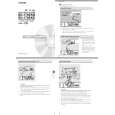
2.14.3 Convergence point adjustment (5) Existing DATA in ROM can be read by
pressing the SWAP button 2 times. This
Adjustment preparation
data can be used after replacing a
(1) Select color to adjust.
component (CRT, DY, etc.) Where complete
?RECALC? - Green
convergence adjustment is not necessary
?0? - Red
be careful not to overwrite this data.
?INPUT? - Blue
DO NOT write cleared RAM data into ROM
(2) Use 4, 6, 2, and 5 to move the cursor position
or a complete convergence adjustment will
(dotted lines).
be necessary.
(3) Use cursor buttons to move the convergence
point.
(4) Three adjustment modes are available:
1. (3x3) Press ?RECALL? 5 times 2.14.4 Digital Convergence Remote Control
2. (7x5) Press ?0? 5 times
3. (13x9) Press ?INPUT? 5 times
NOTE: 3 x 3 mode can only be accessed at start
of adjustment from clear data in ram adj.
mode.
For touch-up, only the (13x9) mode is necessary.
POWER
This will adjust every cross-hatch intersection point
Cl
on the screen.
For complete adjustment, start with (3x3) mode. This
will adjust center point and eight edge points only, HELP PIP CH
but will greatly reduce adjustment time. Then use Phase-
(7x5) mode, and finally (13x9) mode to finish PIP SWAP MOVE FRZ
convergence. Raster
Position
If ?S? distortion appears between cross-hatch lines ROM - ROM
Read
Write
repeat (7x5) mode to change calculation process
while adjusting to remove distortion, then return to
(13x9) mode to finish touch-up convergence.
LST-CH
Adjustment procedure
(1) Start adjustment at the center of the screen. 0
MUTE
(2) Continue adjustment at next closest position.
(3) Adjust center area first, ending with edge
sections. Crosshatch/
-Video Mode
(4) When convergence is acceptable, press MOVE EXIT
Remove
to write data to ROM memory. ROM WRITE? is Color
displayed to alarm system that ROM will be
Green
overwritten with new data. Press the MOVE
(3 X 3 Adj.) -Adjustment
button again to write displayed data to ROM.
(5) DATA WRITE TO ROM will take approximately
20 seconds and no picture will be displayed. CURSOR CONTROL
(6) Green dots will be displayed when operation is -Cursor Up
complete.
(7) Press MUTE to return to convergence pattern,
Cursor Left - -Cursor Right
then confirm again convergence is acceptable.
Cursor Down -
Notes: (1) Display only green for easier adjustment
Blue
and match to jig screen. Press ?MENU?,
(13 X 9 Adj.)
THEN PRESS ?RECALL?.
-(7 XRs?dAdj.)
(2) Write data to ROM after green adjustment.
Once green has been confirmed to match
jig screen, the jig screen can be removed. HWACHI
CLU-435UI
Do not readjust the green color after jig
screen has been removed. This is now your
reference color.
(3) Display green and red only and match red to
green.
(4) Display all colors and match blue to green
and red. Touch-up red color if necessary.
26 |

 ACEC
ACEC