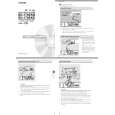
Basic Function/ RadioMP3-CD/ CD PlayerMP3-CD/ CD Player
2 Press CD/USB to enter CD mode if USB is
Basic functionsAbout MP3Finding a passage within a
displayed.
Switching on/off the setThe music compression technology MP3track
� Display will show --- (See 2).
1 To switch on, adjust the source selector to(MPEG1 Audio Layer 3) significantly reduce1 During playback, press and hold down
CD/USB or TUNER as desired.the digital data of an audio CD while 3 To open the disc door, lift the disc door at or §.
the edge marked LIFT TO OPEN.
2 To switch off, adjust the source selector tomaintaining CD quality sound.� The disc is played at high speed and low
4 Insert a disc with the printed side facing upvolume.
OFF.YGetting MP3 files:you can either download
and press the disc door gently to close.2 When you recognize the passage you want,
legal music files from the internet to your
Adjusting volume and sound computer hard disc, or create such files by� Display:The total number of tracksrelease or §.
Adjust the sound with the VOLUME andappears.� Normal playback resumes.
converting audio CD files in your computer
DBB controls.�The disc scanning of MP3-CD may run
through appropriate encoder software.
(128kbps bit rate or higher is recommendedlonger than audio CD.Programming tracks
Radio reception for MP3 files.)5 Press 2; to start playback.You may store up to 20 tracks in the desired
� Display: 2 and the current track number.sequence. If you like, store any track more
1 Push the source selector to TUNER.YCreating a MP3 CD:burn the music files
For MP3-CD/ WMA only:than once.
2 Adjust the BAND to FM or AM to selectfrom your computer hard disc on a CDR or
1 In the stop position, press PROG to start
your desired waveband.CDRW using your CD burner.�The current track number OXXXO and
album number OALB XXXO will be programming.
3 Turn TUNING to tune in a radio station.
Helpful hints:displayed interchangeably (See 45).� Display shows P01 indicating the start of
4 To switch off the radio, adjust the sourcethe program. PROG flashes. (See 6)
selector to OFF.� Make sure that the file names of the MP3 files6 To pause playback press 2;.
end with.mp3.� Display: 2 and the current track number2 Press or § to select your desired track
number.
Helpful hints:� Number of albums:maximum 500 flash.
For MP3-CD/WMA: First press
To improve reception � Number of tracks:maximum 1000 7 Press 2; again to resume playback.
ALBUM+/- once or more to find your album.
Y For FM, extend, incline and turn the � The length of file names affects the number of8 To stop playback, press 9.
telescopic antenna. Reduce its length if thetracks for playback.With shorter file names,3 Press PROG to store the desired track.
Helpful hints:� Display shows P02, indicating the next
signal is too strong.more files can be burned on a disc.The disc playback will also stop when:program location available.
Y For AM, uses a built-in antenna. Direct this�you open the disc compartment door;
4 Repeat steps 2 to 3 to select and store all
antenna by turning the whole set.�you select TUNER or OFF position;desired tracks.
Playing a disc� the disc has reached the end of the playback.
5 Press 2; to play the program.
This player plays Audio Discs including CD-R/
CD-RW, MP3 CD and WMA. Do not try toTo review your program
Selecting a different track
play a CD-ROM, CD-I, CDV,VCD, DVD orIn the stop position, press and hold PROG 3
Y Press or § once or repeatedly until the
computer CD.seconds.
desired track number appears in the display.�The display shows all the stored tracks in
IMPORTANT!
For MP3-CD/WMA: First presssequence.
YCDs encoded with copyright protectionALBUM+/- once or more to find your
Helpful hints:
technologies by some record companies mayalbum.� Display shows P01 if no track is
be unplayable by this product.
Y In the pause/stop position, press 2; to startprogrammed.
YDRM-protected WMA disc is not supported.playback.� If you try to store more than 20 tracks, no
1 Adjust the source selector to CD/USB.track can be stored and the display will show
� Display shows - - - (see 2), or - - - withFUL.
OUSB� (see 3) |