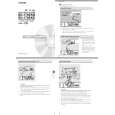
Connecting Accessory Devices to Your TV
CONNECTINGA STANDARD DVD PLAYER
omponent video inputs allow the highest pos-Rear of TV
HDINPUT-AV4
Csible color and picture resolution in the play-
1G/Y
back of digital signals, such as those of DVD
R/Pr
ANTENNAIN751INPUT-AV1OUTPUTINPUT-AV2
players. The color difference signals (Pb, Pr) and
2
YB/Pb
the luminance (Y) signal are connected andVIDEOVIDEO
S-VIDEO LPbS-VIDEO LV
received separately. The result is better color
LLL
SYNC
bandwidth information than is possible with com-AUDIOPrAUDIOHAUDIO
RRR
posite video (labeled VIDEO on your TVOs jack
panel) or S-Video connections.
To make the connections shown in this example,Rear of DVD Player*
you will need:
Y three cables for video connections (standard
11
RCAconnectors)PCM-MPEG2-Dolby Digital-DTSDIGITAL AUDIO OUT
22
Y two cables for audio connections (standardRL(CVBS)PR/CRPB/CBY(Y/C)
COAXIALOPT OUTSUB WF OUTAUDIO OUTVIDEO OUTVIDEO OUTS-VIDEO OUT
RCAconnectors).
NOTE:The cables are not supplied with your TV*(Example: Philips D.VD model DVD712)
You should be able to buy them at most stores
that sell electronics. Or you can call ourHELPFUL HINTS
Customer Care Center at 1-800-531-0039.Y To simplify making connections, the con-
CVI
nectors on audio and video cables are
BEGIN
often color coded. The jacks on your TV
Connect the YPbPr (component)are likewise color coded to match the
VIDEO OUT jacks from the DVD playerconnectors. The coding is as follows:
1
to the INPUT-AV 1 YPbPr (componentN Green for component video Y
video) jacks on the rear of the TV.N Blue for the component video Pb
NOTE: The INPUT-AV 1 YPbPr jacksN Red for the component video Pr
will accept 480i (interlaced) output sig-N Red for the right audio channel
nals onlyThe connection example on this.N White for the left audio channel.
page assumes the use of a DVD player
Y The names for the component video jacks
with interlaced output. Some DVD play-POWER
may differ depending on the DVD player
ers, however, have YPbPr outputs that can
or accessory digital source equipment
be switched between interlaced and pro-
used. For example, besides YPbPr, you
gressive scan. If you are attempting to use
may see R-Y/B-Y/Y; or CrCbY. Although
a DVD player with progressive-scanTVVCRACCabbreviations and terms may vary, the let-
ACTIVE
(480p output) capability to make the con-SWAPPIP CHCONTROL FREEZE
ters Band Rstand for the blue and red
nection shown in this example, you mustDNUP
color component signal connectors, respec-
PICTURE
be sure to switch the DVD player to inter-SOUND
tively, and Yindicates the luminance sig-
laced. If necessary, refer to the DVD play-
nal. If necessary, refer to the directions-for-
erOs directions-for-use manual for help. IfSTATUS/MENU/SELECT
EXITuse manual for your DVD or digital acces-
you want to use the DVD player in pro-
sory for more information.
gressive-scan mode, you must use the HD
MUTEY You can also connect a satellite receiver
INPUT-AV 4 jacks (see page 11).
VOLCHto the TV in a manner similar to the
Connect the AUDIO OUT L(eft) andexample shown on this page. If you con-
R(ight) jacks from the DVD player to thenect a satellite receiver to the TV, you
2
INPUT-AV 1 AUDIO jacks on the rear of132will need to use the receiverOs channel-
the TV.memorization system to store channels in
465
the receiverOs memory.
Press the AV button on the remote con-798
trol as many times as necessaryto selectTV/VCRY If you experience difficulties receiving
3A/CH0SURFsound with a DVD disc, check the sound
the CVI (component video input) source
settings through the DVD discOs menu.
on the TV.
SURFPIP ON/OFF
3REC YFORMATSLEEP
SAPY The CVI signal source cannot be dis-
Turn the DVD player on and press
AVDOLBY V PROG.LISTplayed in the PIP window.
PLAY to view the DVD program on the
4
TV.ITR/RECORDHOMEVIDEOHOMEMOVIES PERSONAL
WARNING
POSITIONPIP
To prevent uneven picture-tube aging, do not
leave nonmoving images or black borders on
the screen for an extended period. See page 57.
10 |